This article first took shape after a long-time volunteer from Amigos de Bolsa Chica shared the importance of plastic-free holiday gift giving, especially in a world where plastic has become the default. It truly made me reflect on my own holiday experience where the living room floor is covered in crumpled wrapping paper, plastic packaging, ribbons, and containers that were used once and then tossed away.
Now, imagine your own holiday experiences. How much wrapping paper, plastic containers, tape, and disposable decor do you end up having to pick up and throw away at the end of the day? According to the Environmental Protection Agency (EPA), “the volume of household waste in the United States generally increases 25 percent between Thanksgiving and New Year’s Day, from four million tons to five million tons.” (EPA). The increase in waste during the holiday season contributes significantly to environmental pollution. It’s also important to recognize that this statistic leaves out other gift-giving holidays and birthdays.
The production and disposal of these materials also contribute to greenhouse gas emissions, exacerbating climate change. This excessive use of single-use plastics and non-recyclable materials leads to more landfill accumulation, which can take centuries to decompose. But what happens to the plastic and non-recycleable materials that don’t end up in landfills?
Where does our trash go?
While much of our plastic waste finds its way to landfills, some ends up in our oceans, where it contributes to a growing environmental crisis. When you see litter on the sidewalk, rain drifts the trash down to our ocean. Plastic waste is especially problematic due to its durability and resistance to decomposition, allowing it to persist in the environment for decades or even centuries.
This is why everyday choices, like reducing plastic packaging or choosing plastic free-gifts matter. Preventing plastic from entering the waste stream in the first place helps reduce the amount that can escape into natural ecosystems.
*Side note: why is decomposition important? Everything in this world has a natural process of returning back to the planet. This is called the process of decomposition; it is what helps life continue to thrive. When we compare the natural materials vs the anthropogenic materials decomposition, the statistics make it significantly clear. Below is a graphic to help you visualize the time it takes to decompose plastic materials.
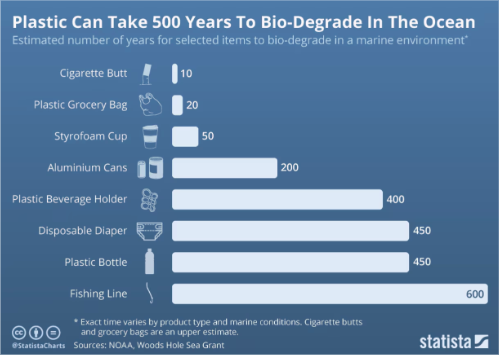
Estimated number of year for selected items to bio-degrade in a marine environment.
My Personal Experience
For my minor in Global Sustainability, I was required to attend the Festival of Whales in March, 2026 to present my group project, “Global Warming: The Physical and Biological Implications”that we worked on during our Winter Quarter. Before our presentation, we participated in the Stand Up to Trash event, where volunteers collected litter along Dana Point Beach.
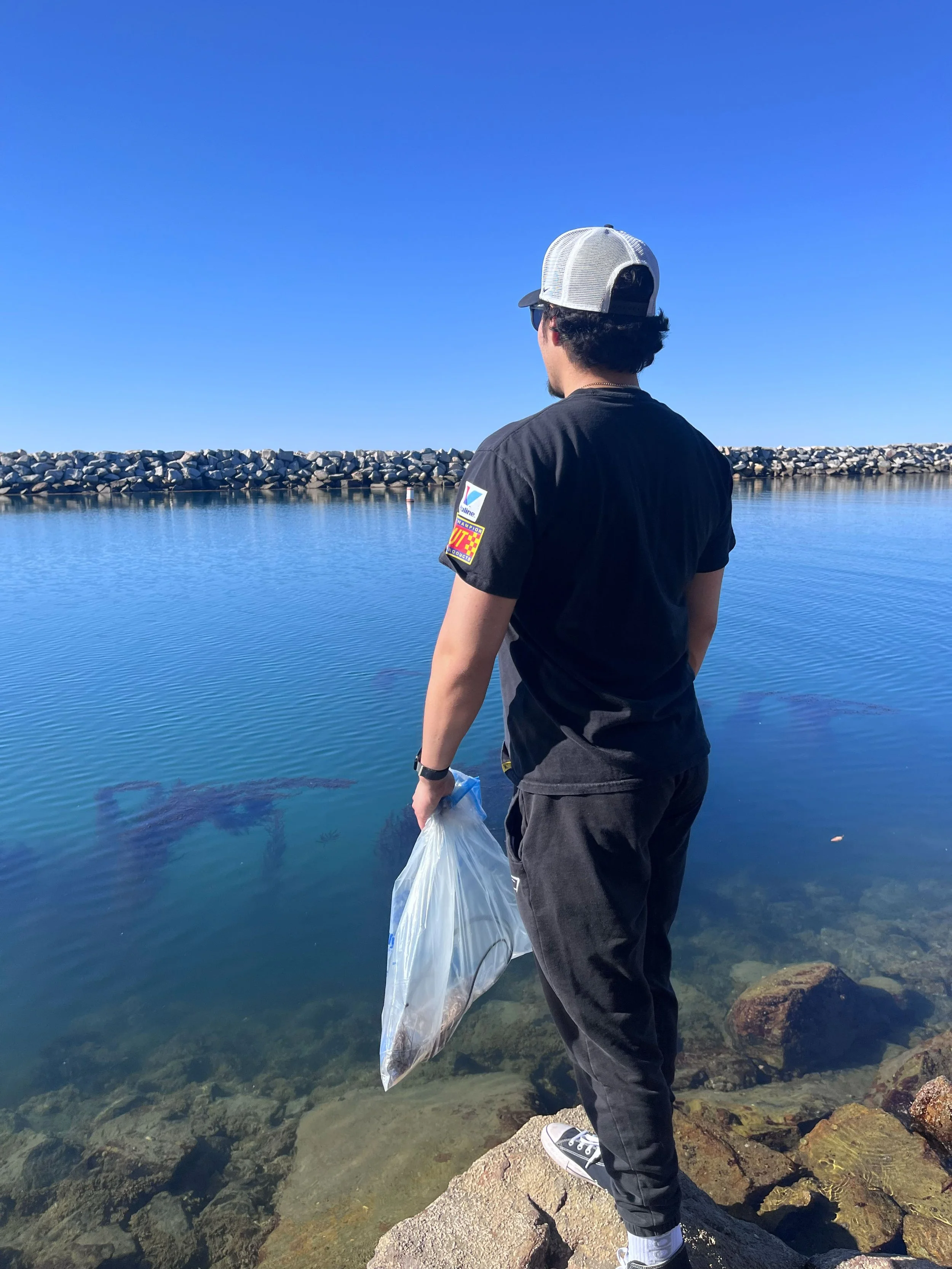
Despite the area initially appearing relatively clean, a closer look at things revealed the numerous fishing lines hidden between rocks, near the shoreline, or tangled in seaweed. Thankfully, my brother and cousin came to support me and helped pull these fishing lines out from under and between rocks. The image to the right is a picture of my brother holding onto his bag of trash. Although the bag may not appear full, you can see the clumps of fishing lines inside. That was by far the most difficult and tedious type of plastic to remove.
I spent two hours at this event collecting plastic across the beach, picking up every strand of fishing line, every discarded Starbucks cup, and every single-use plastic straw I came across.
Bolsa Chica - A Wetland
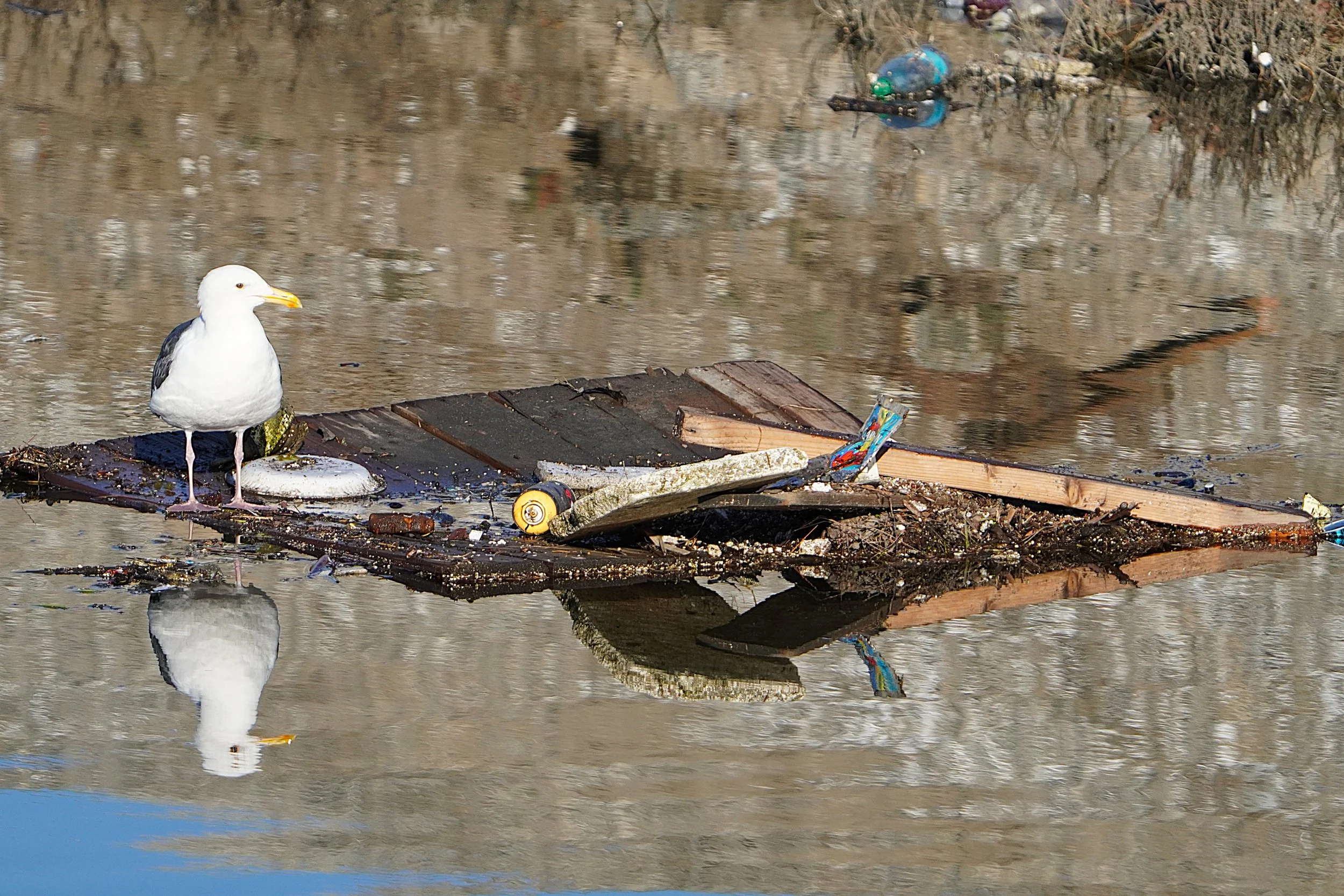
Western Gull on trash raft, Wintersburg Channel, 1-16-2026. Photo by John Carter.
Wetlands like our own Bolsa Chica Ecological Reserve (BCER), are vulnerable to these kinds of pollution. Especially because much of the pollution is carried through rivers, storm drains, and coastal currents. As a coastal marsh, Bolsa Chica supports a rich biodiversity of wildlife, including migratory birds, fish, and invertebrates that depend on clean water and healthy habitats.
The ecosystem we see today is the result of decades of community effort to protect, preserve, and eventually restore. Major restoration efforts occurred from October 2004 to August 2006, ultimately reconnecting tidal flow and working to return the wetlands to functional ecosystems with tidal influence on its natural ecological state. Because so much effort has gone into restoring Bolsa Chica, protecting it from pollution is especially important.
Trash in wetlands can harm wildlife directly through ingestion or entanglement and is known to also degrade habitat quality (U.S. Fish and Wildlife Service). Monitoring plastic pollution allows researchers and conservation groups to understand where waste is accumulating, what types of debris are most common and how pollution patterns change over time. This invaluable information helps guide our cleanup efforts, policy decisions, and community education.
Unfortunately trash accumulation along this coastline is not new. In fact, what is now Bolsa Chica State Beach was once nicknamed “Tin Can Beach” in the 1950s because campers had discarded an estimated 300 tons of trash along the shoreline. Even today, debris can be seen in the marsh; the image above shows a Western Gull on a trash raft by Wintersburg Channel, photographed by our Naturalist, John Carter. Scenes like this remind us, naturalists and the public alike, that plastic pollution continues to affect coastal ecosystems.
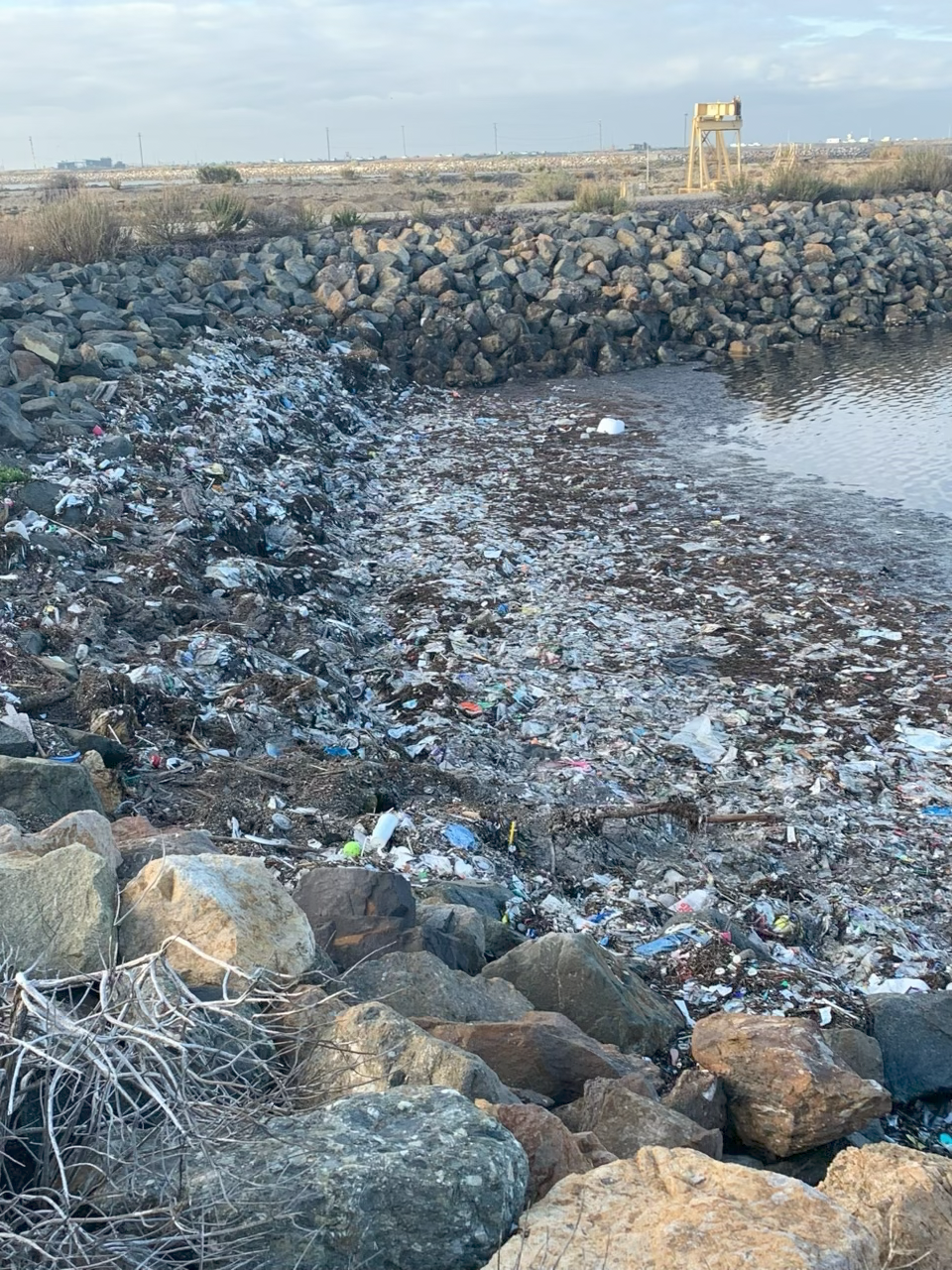
Plastics and other debris accumulating in the Full Tidal Basin.
The Project
In the fall of 2025, Amigos de Bolsa Chica received a grant allowing the Los Cerritos Wetlands Stewards to clean up a mile stretch of Bolsa Chica’s Full Tidal Basin. During this project, nearly 30,000 pounds of trash and debris was collected in just eight workdays. Following this, the Amigos was awarded a second grant to monitor the basin for plastic pollution and create a document of visual records on the circulating and accumulating plastic, debris, and trash that informs the California Department of Fish and Wildlife staff at BCER how and where to proceed with the installation of trash interception booms in sensitive habitats.
The only way we could see how the trash moves and fluctuates was to install five time-lapse cameras around the Full Tidal Basin in areas already known to accumulate plastic and other debris. Ultimately, the data captured from the cameras informed the California Department of Fish and Wildlife staff where best to place interception booms that will capture the trash before it settles on the rocks and mudflats (the purchase of booms is likely to be a future grant).
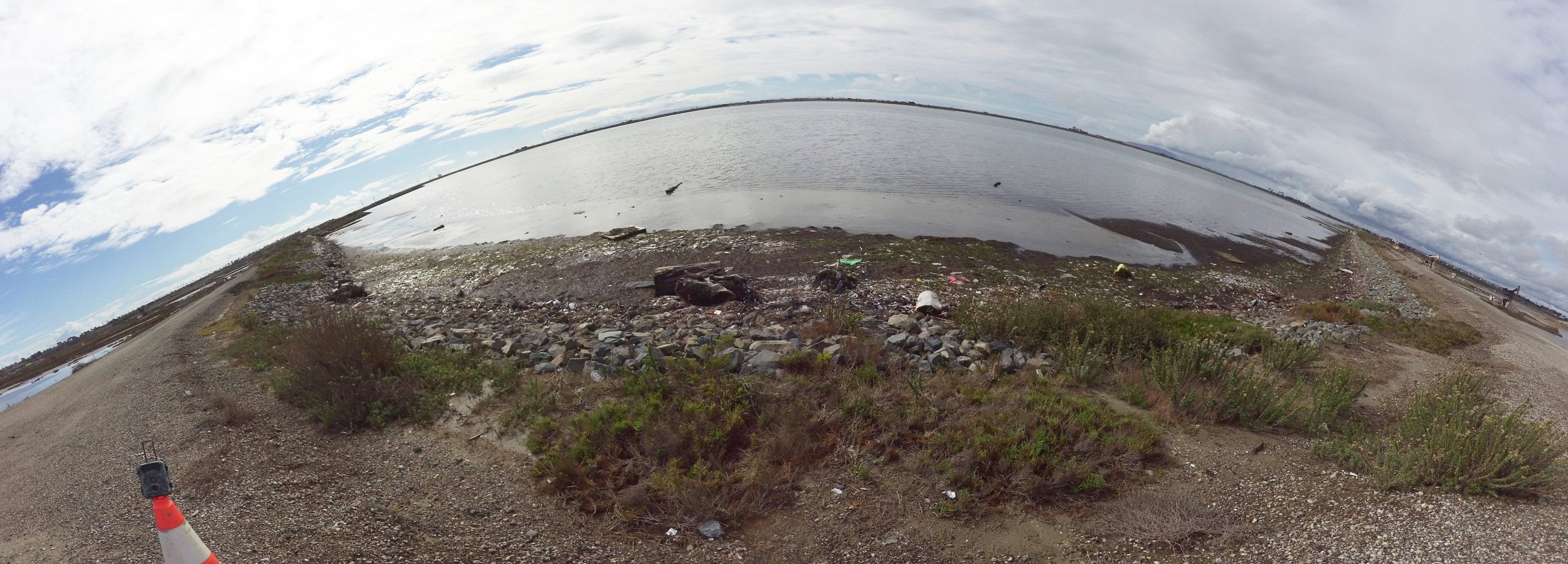
The photo above was taken by one of the cameras installed around BCER to monitor plastic pollution for the Full Tidal Basin Plastic Pollution Monitoring project.
Why does it matter?
Plastic pollution is a global concern because its impact has now extended from visible waste, polluting our waters to our food systems and even our bloodstream. In an early study, they found that in “17 of 22 blood samples drawn from a group of volunteers…80% had some concentration of microplastics” (Health Policy Watch). This study was done in 2022, when microplastics were found in human blood for the first time.
As mentioned before, plastics do not simply decompose. They are designed to be photodegradable, causing them to break down when exposed to UV light. This process is exactly what’s so concerning about plastic pollution being found in our bodies of water. As plastic reduces into smaller pieces, they become microplastics. These microplastics are often eaten by smaller fish, and those fish are consumed by larger fish that must eat huge quantities of little fish to survive. The larger fish may be consumed by even larger fish or mammals or birds of prey and often end up in our dinner tables. Bio-accumulation is the result: the predator unintentionally absorbs and stores the combined chemical dose of every single fish it ate. Animals at the very top of the food chain (like eagles, killer whales, and humans) receive the highest and most concentrated doses of microplastics and other toxins.
A more recent study further shows that both micro and nanoplastics have been discovered throughout “different locations of the human body, including in our lungs,” though the extent in which these micro and nanoplastics chemicals from the plastic effect it has on the body is still unknown. However, according to Environmental Science and Technology, “many microplastic chemical additives have been widely associated with well-established human health risks” and even more concerningly so, another study has estimated that “adults take in up to 121,000 microplastic particles per year through air, food, and beverages.” (Ocean Conservancy).
Plastic is a pollutant that should be perceived as a great environmental concern because it has infiltrated ecosystems worldwide, our wildlife, and our human body systems itself.
What can you do?
While the purpose of this blog is to bring awareness, it is also meant to act as a guide to help consumers better understand their choices and how it all connects to our environment. I have composed a list of meaningful, lower-waste gift alternatives that reduce environmental impact while still being kept personal and special.
Plastic-Free & Low-Waste Gift Alternatives
Tickets/Season passes to an entertainment venue or zoo. Example: Annie, our very own Program Manager at Amigos, gifted her niece tickets to the aquarium!
Homemade gifts: Candies, treats, baked goods, jams/jellies, arts and crafts. Example: Former President of the Amigos de Bolsa Chica, Jerry, brought his wife’s, Lori, amazing pumpkin spice gingerbread cookies to our FLOW Friday event! Click here for link to Lori’s Pumpkin Spice Gingerbread Cookies: Lori's Pumpkin Spice Cookies Recipe!
Plants 🪴would be an excellent gift for those who are environmental enthusiasts! Purchase native plant species if possible! Here is a link to a list of SoCal’s native Coastal Sage Scrub plants: Tips for coastal scrub gardening. Envision your garden through the CalScapes Virtual Garden Planner: https://calscape.org/garden-planner/welcome
Reusable water bottles, travel mugs, and wooden cutting boards!
Buy them clothes! During Amigo's first Saturday event, we sell T-shirts with Bolsa Chica’s native birds and all proceeds go to our movement to protect our coastline, so not only are you purchasing a gift, but also supporting your local environment! Sign up for our first Saturday events: First Saturday of the Month Wetland Tour
Alternatives to wrapping paper
Reusable paper bags
In California, stores have banned most plastic carryout bags, now we have reusable paper bags that can be used as decoration for gift wrapping!
Scarves
If you have an old scarf/extra fabric, you can use them to wrap gifts! Here’s a friendly video to show you how: Eco-friendly festive gift wrapping with a scarf - Furoshiki tutorial No.23 - Christmas
Newspaper
Wondering what to do with all the extra paper from your mail? If not recycled, you can use them to wrap gifts!
Closing Remarks/Conclusion
This guide isn’t extensive nor is it about living a perfect sustainable lifestyle, but we strive to promote awareness. Amigos de Bolsa Chica encourages you to join us in living a more sustainable lifestyle by starting with small intentional shifts away from plastic and towards a thoughtful alternative for our environment. By reducing plastic consumption, including doing more sustainable gift giving, we can help decrease the amount of plastic waste that eventually reaches places like Bolsa Chica.
Thank you, Fellow Community Scientists
References
https://www.fws.gov/project/marine-debris-ocean-litter-and-how-it-affects-wildlife-northeast
Statistic Graphic: https://www.weforum.org/stories/2018/11/chart-of-the-day-this-is-how-long-everyday-plastic-items-last-in-the-ocean/
https://healthpolicy-watch.news/microplastics-found-in-human-blood/
https://publications.ersnet.org/content/errev/33/172/230226.abstract
https://pubs.acs.org/doi/10.1021/acs.est.7b00423
https://oceanconservancy.org/newsroom/fact-sheets/
For more information:
Take the wildlife calculator after a beach cleanup event!